
Cisco Common Policy is designed to close that gap.
Why policy consistency is still hard
In distributed environments, policy drift is almost guaranteed:
- Different domains use different policy languages and constructs
- Teams duplicate policy logic across tools and consoles
- Context about users, devices, and workloads does not move cleanly between domains
- Zero Trust initiatives stall at domain boundaries
So even when a security strategy is sound, execution gets fragmented.
What Cisco Common Policy changes
Cisco Common Policy introduces a shared framework that aligns policy intent across network domains. With Cisco Identity Services Engine (ISE) being the context exchange hub, many organizations already have the tool for the job.
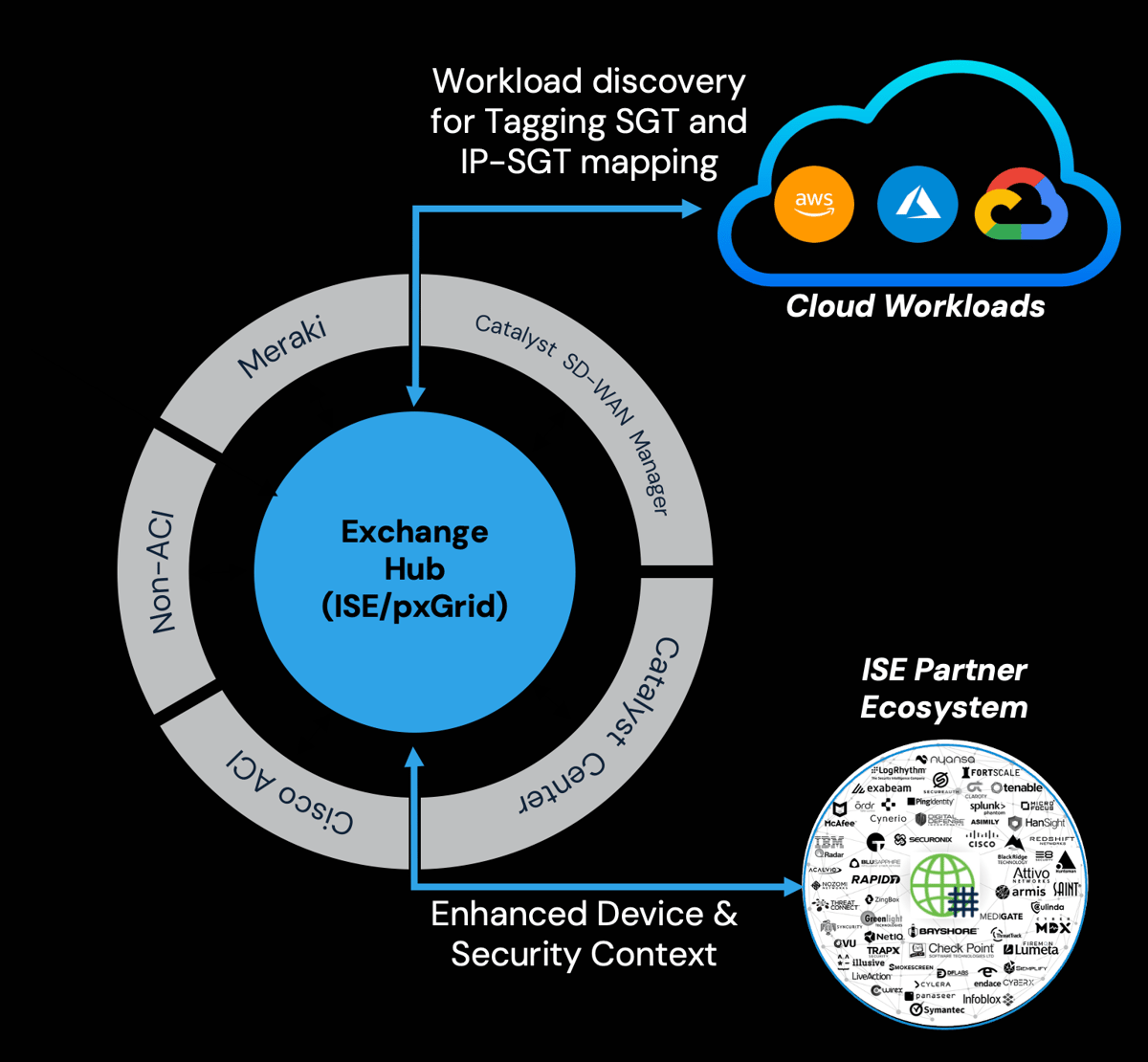
At a high level, it does three important things:
- Creates context near where it naturally belongs: user and device context at the access layer, application context in the data center and cloud
- Normalizes context into a common construct: Security Group Tags (SGTs)
- Shares that context through Cisco ISE as the exchange hub, so enforcement domains can apply consistent policy based on the same identity and workload signals
This is the key shift: create policy logic once, then apply it consistently wherever enforcement happens.
Where this matters most
When implemented well, Common Policy supports consistent controls across:
- Wired, wireless, and VPN access
- Firewall domains
- Data center environments such as ACI and VMware
- Cloud platforms such as AWS, Azure, and Google Cloud
- Branch and edge environments, including SD-WAN and Meraki
That means fewer translation errors between domains, less manual policy duplication, and faster policy rollout.
Operational impact for security teams
The business value is not just architectural elegance. It is operational:
- Reduced redundancy in policy design and updates
- Lower risk from inconsistent access and segmentation controls
- Faster adaptation to user, device, and workload changes
- Better visibility for monitoring and troubleshooting
- A stronger foundation for scalable Zero Trust enforcement
In practical terms, teams spend less time reconciling policy differences and more time improving outcomes.
What to evaluate before rollout
If you are assessing Common Policy in your environment, ask:
- How many policy models are we managing today for similar access outcomes?
- Where does context break as users move between campus, branch, VPN, and cloud?
- Which controls are still manually synchronized between domains?
- How quickly can we adapt segmentation and access when business needs change?
- Do we have one coherent policy framework, or several disconnected ones?
Those answers usually reveal whether the current operating model is ready for Zero Trust at scale.
Takeaway
Cisco Common Policy acts as a policy translator across distributed infrastructure. By sharing normalized identity and workload context through ISE, organizations can enforce access and segmentation with more consistency, less operational drag, and better security resilience.
Zero Trust and Micro-Segmentation projects do not fail because intent is unclear. It fails when policy cannot travel cleanly across domains.
See it for yourself. Request a ModernISE Platform test drive at moderncyber.com/testdrive — or reach us at info@moderncyber.com.
Integrated · Agile · Zero Trust · AI