
How Microsoft approaches zero trust — principles, reference architecture, and maturity model.
Overview
Definition
Instead of assuming everything behind the corporate firewall is safe, the Zero Trust model assumes breach and verifies each request as though it originates from an open network. Regardless of where the request originates or what resource it accesses, Zero Trust teaches us to “never trust, always verify.” Every access request is fully authenticated, authorized, and encrypted before granting access. Microsegmentation and least privileged access principles are applied to minimize lateral movement. Rich intelligence and analytics are utilized to detect and respond to anomalies in real time.
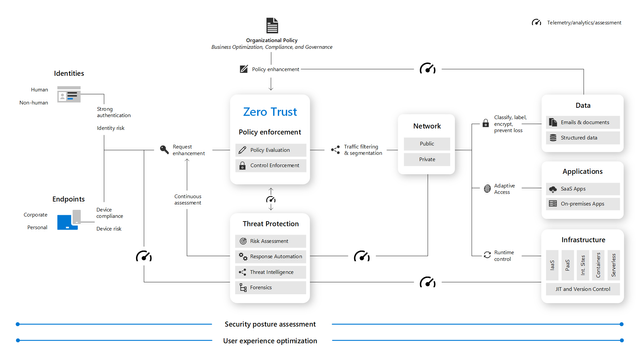
Principles
- Verify explicitly
- Always authenticate and authorize based on all available data points, including user identity, location, device health, service or workload, data classification, and anomalies.
- Use least privileged access
- Limit user access with just-in-time and just-enough-access (JIT/JEA), risk-based adaptive polices, and data protection to help secure both data and productivity.
- Assume breach
- Minimize blast radius and segment access. Verify end-to-end encryption and use analytics to get visibility, drive threat detection, and improve defenses.
Architecture
Top Resources
Where is your zero trust maturity today? Benchmark your environment against CISA and NIST models with a ModernCyber Zero Trust Assessment — or talk to an engineer.
Integrated · Agile · Zero Trust · AI