
This is the first post in a three-part series introducing the MoCy Platform.
The 25-year-old problem nobody solved
For a quarter of a century, every enterprise has built its critical network services the same way. Size the nodes. Argue with the virtualization team for resources. Design DNS, NTP, SMTP, and identity integration. Engineer load balancing. Validate WAN latency. Stand up certificates, backups, and storage. Plan the upgrade. Miss the patch. Nurse the outage. Repeat.
Not once per industry. Not once per vendor. Once per company, per service, per site — forever. Tens of thousands of organizations have independently solved, and re-solved, the same infrastructure puzzle, and every one of them is still paying the maintenance bill on their own bespoke answer.
We watched this from the inside for two decades — designing network access control and zero trust architectures for some of the largest networks in the world. We saw what it produces. In one recent health assessment of a multi-national enterprise, a large Cisco ISE deployment across 10 countries had generated over 30 TAC cases and multiple outages in a single year — disk failures, expired maintenance windows, backups running during production hours, and a software release that hadn't been rebooted in 200+ days. The root cause wasn't the product. The root cause was that critical infrastructure was being run like a pet: hand-fed, hand-named, and hand-repaired by heroes.
The rest of the software world left this model behind fifteen years ago. Cattle, not pets. Infrastructure as code. Immutable, rebuildable, monitored, automated. Enterprise network services — the systems that decide who and what gets on your network — somehow never made the trip.
So we built the platform that takes them there.
First principles, not incremental fixes
If you designed enterprise network service delivery from scratch in 2026, you would not start with a shipped appliance or a VM template and a 40-page install guide. You would start with four requirements and refuse to compromise on any of them:
- Integrated. Every service arrives with everything it needs — routing, VPN, load balancing, DNS, certificates, backups — already engineered in. No prerequisite scavenger hunt.
- Agile. A production-grade, multi-region deployment should be an afternoon, not a quarter. Change should be a checkpoint away from being undone.
- Zero Trust. Least privilege everywhere — in the services we deliver, and in the platform that delivers them. The control plane should not be able to touch your data even if it wanted to.
- AI. Not a chatbot bolted onto a dashboard — an API-first platform where intelligent agents can observe, assess, and eventually operate infrastructure, privately, alongside your data.
Integrated · Agile · Zero Trust · AI. That has been ModernCyber's approach since our founding, and the MoCy Platform is that approach expressed as software.
A layered, distributed architecture
The MoCy Platform is built as four distinct tiers, and the boundaries between them are the whole point.
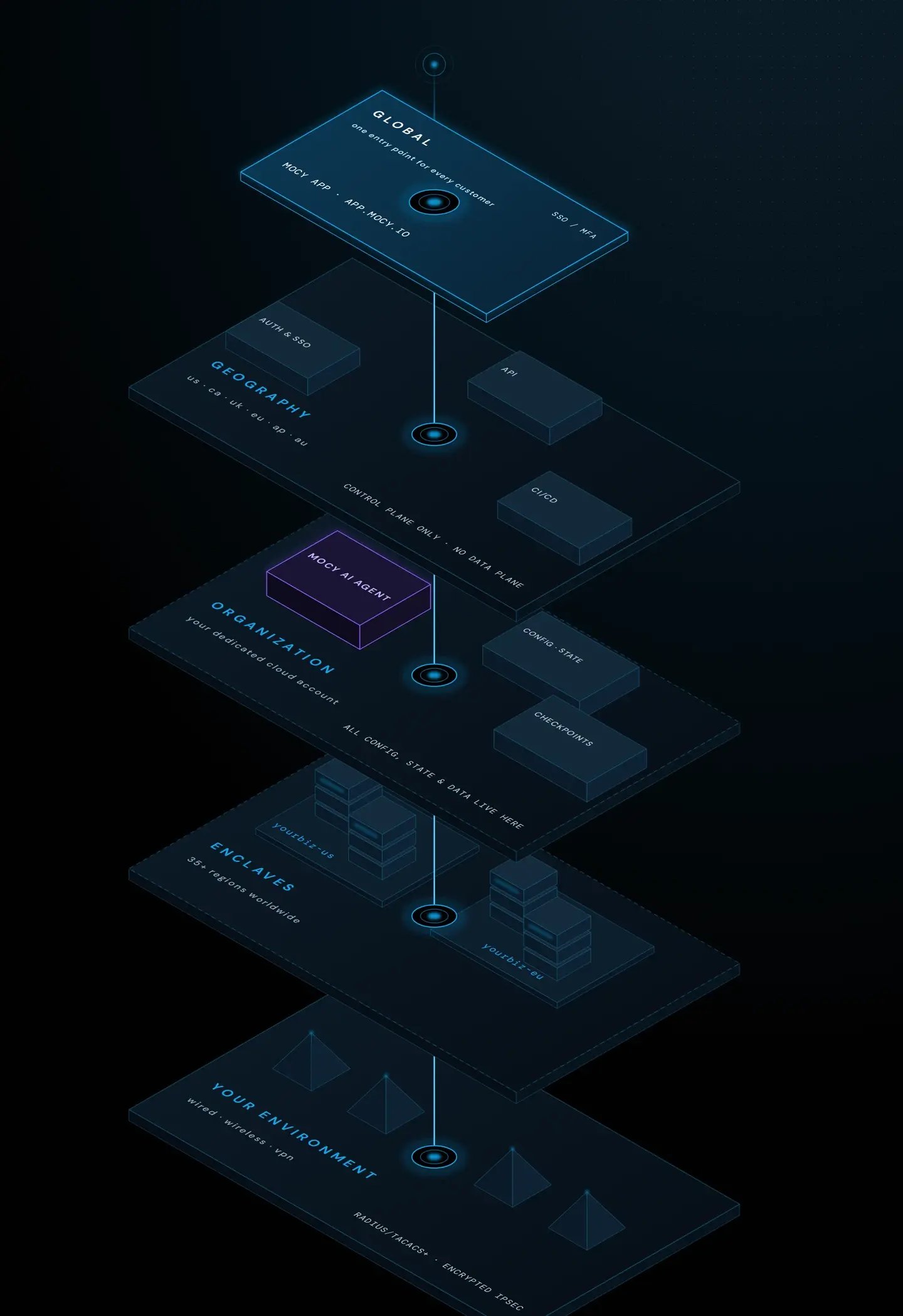
Global is the single front door: the MoCy App at app.mocy.io, one entry point for every customer, with platform authentication and MFA — or single sign-on through your own identity provider.
Geography is where the platform's control plane actually runs — in the United States, Canada, the United Kingdom, the European Union, Asia Pacific, and Australia. When you create a MoCy organization, you bind it to a geography, and that binding is real: your platform services, your API, and your automation pipelines run there. This tier is control plane only. It has no data plane and no direct IP access to your systems. It orchestrates; it does not touch.
Organization is yours. One organization, one dedicated cloud account, where every piece of your configuration, state, checkpoints, and backups lives. Not a row in our multi-tenant database — your own account, in your chosen geography. This is also where the MoCy AI Agent runs, next to your data rather than across the internet from it (more on that in part three of this series).
Enclave is where your services actually run: single-tenant, sovereign environments deployed across one or more cloud regions, each carrying the service infrastructure and the interconnects that link it back to your network. Deploy across 35+ regions worldwide. An enclave in Frankfurt keeps EU data in the EU. An enclave in Sydney keeps Australian data in Australia. Sovereignty isn't a compliance checkbox we added later — it's a property of the architecture.
Down the side of all of it runs lifecycle automation: design, deploy, interconnect, monitor, assess, checkpoint. The platform deploys and updates every service in every tier with no manual operations. Nothing is hand-built, which means everything can be rebuilt — an entire deployment can be re-created from code in hours, and swapped in behind load balancing with zero downtime.
Privacy is not a feature. It's the floor plan.
Most cloud-delivered network services make you a tenant in someone else's house. Your policy, your logs, your authentication events — the most sensitive metadata your network produces — pooled into a shared platform, protected by a promise.
We think promises are the wrong primitive. Architecture is the right one.
- All of your configuration, state, and data live in your dedicated cloud account — isolated from every other customer by the cloud provider's hardest boundary, not by an authorization check in application code.
- Your organization is pinned to your geography. Data sovereignty is enforced by where your enclave physically exists.
- The global and geography tiers are control plane only — no data plane, no direct IP access into your enclaves or your network.
- Your network traffic — RADIUS and TACACS+ from your wired, wireless, and VPN infrastructure — flows over encrypted IPsec into your enclave and nowhere else.
One global app. Geographic sovereignty. Your own global enclave. That combination is why a bank, a hospital, and a government agency can each use the same platform and none of them has to trust the others' neighborhood.
Minutes and hours, not weeks and months
Here is what the architecture buys you in practice. A traditional deployment of a critical network service means weeks of design before anything gets built: node sizing and placement, hypervisor resource negotiations, DNS/NTP/SMTP integration, load balancer configuration, latency validation, certificate and backup design. On the MoCy Platform, you answer a short set of design questions in the app, and orchestration builds the rest — nodes, load balancing, DNS, certificates, backups — with sizing, latency, and inter-node design pre-engineered into the platform. From our own delivery experience, roughly 40% of the design and knowledge burden of a deployment simply disappears, and time-to-production collapses from weeks or months to hours.
And because the platform never stops watching — continuous health assessments, drift detection, real-time telemetry, automated upgrades, patches, and certificate renewals — the deployment you have in year three is as clean as the one you launched on day one. The status quo is not the safe option; expired certificates and missed patches are what our health assessments find most often. Doing nothing has a cost, too.
ModernISE is first. It is not last.
The first service on the platform is ModernISE — cloud-delivered, fully managed Cisco Identity Services Engine as a service. We started with ISE deliberately: network access control is one of the hardest, most infrastructure-entangled services an enterprise runs, and it sits at the exact intersection of our team's two decades of expertise. Bring your own ISE licenses, keep the familiar ISE admin experience, and let the platform run everything underneath it. It's available today, worldwide, on the Cisco Global Price List through your preferred Cisco partner.
But the platform was never about one product. Every tier you saw above — the sovereignty model, the enclaves, the interconnects, the AI agent — is service-agnostic by design. ModernISE proves the model on the hardest problem first. More services will follow it onto the same rails.
The enterprise network is the last part of the enterprise still built by hand. We intend to change that — secure, resilient, reliable networks, built in minutes and hours instead of weeks and months, private by architecture rather than by promise.
See it for yourself. Request a ModernISE Platform test drive at moderncyber.com/testdrive — or reach us at info@moderncyber.com.
Integrated · Agile · Zero Trust · AI